How to Choose a Portable Heater Based on Room Size & Insulation
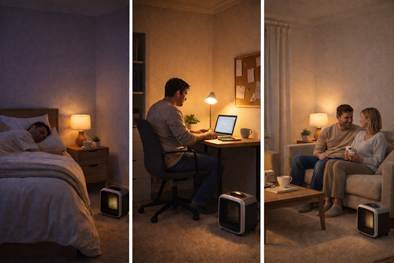
Selecting the right portable heater isn’t about perfect engineering calculations. It’s about matching heat output to how a room is used. Most portable heaters aren’t designed to heat an entire home continuously.
In real life, they’re typically used:
- in short bursts;
- in specific zones (desk, sofa, bedside);
- to supplement existing heating;
- within the limits of normal household electrical capacity.
So, the goal isn’t “maximum watts.” The goal is simpler:
Reliable comfort without wasting energy — or buying a heater that can’t realistically do the job.
This guide gives you a sizing method you can apply quickly, plus practical decision rules to avoid the most common heater mistakes.
What you’ll get from this guide
By the end of this guide, you’ll know:
- roughly how many watts you need;
- whether one heater is enough, or you need two;
- why room height and insulation change everything;
- when spot heating beats whole-room heating;
- how to make a decision that works in UK, EU, and US homes.
Decision Shortcut (30 seconds)
If you want the fast answer, use this:
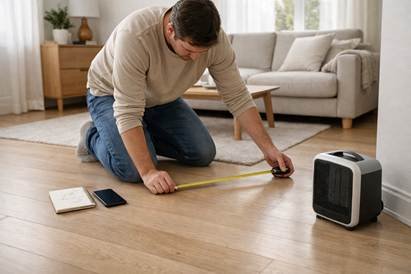
Step 1 — Measure your room volume
Room volume (m³) = floor area (m²) × ceiling height (m)
Step 2 — Choose your room condition
Use one of these realistic ranges:
| Room condition | Power needed |
| Well insulated, minimal drafts | 25–30 W/m³ |
| Average insulation | 30–40 W/m³ |
| Poor insulation, drafts | 40–50 W/m³ |
Step 3 — Multiply
Room volume × W/m³ = your target watts
Step 4 — Reality check
- If your result is over ~1,500W, one heater may struggle to heat the whole room evenly.
- In bigger rooms, two heaters or spot heating often gives better comfort than forcing one unit.
If that shortcut already gives you a clear answer, skip down to One Heater or Two? (Decision Table).
Why Traditional “Heat Loss” Formulas Fall Short for Portable Heaters
You may see formulas like this online:
Q = 100 W/m² × S × K1 × K2 × K3 × K4 × K5 × K6 × K7
They try to account for:
- window type;
- wall insulation;
- climate severity;
- ceiling height;
- number of external walls.
Conceptually, this approach makes sense — but it’s built for central heating systems, not portable heaters.
The problem is how portable heaters are actually used
These formulas tend to overestimate because they assume:
- continuous operation;
- worst-case outdoor conditions;
- heating the entire room evenly at all times;
- “air temperature = comfort” (which is often not true).
Portable heaters don’t behave like a boiler + radiators. They’re comfort tools — and the most useful sizing method is the one that reflects real usage.
That’s why DecisionEdit recommends a volume-based approach, which stays accurate across different ceiling heights and insulation levels.
The Recommended Method: Volume-Based Heater Sizing (W/m³)
Instead of pretending to calculate perfect heat loss, this method estimates how much heated air you realistically need for comfort.
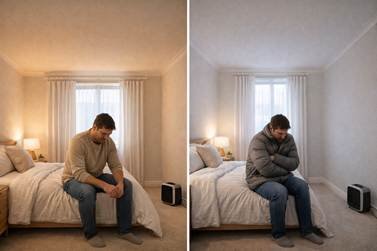
Why it works in real homes
It aligns with:
- intermittent use;
- standard heater power ranges (roughly 500–2,000W);
- comfort-driven heating (not theoretical balance);
- the fact that insulation determines whether heat stays useful.
How to size your heater (simple method)
Step 1 — Calculate room volume
Room volume (m³) = floor area (m²) × ceiling height (m)
Step 2 — Apply a heat density range
Choose a range based on insulation and drafts:
| Room condition | Power needed |
| Well insulated, minimal drafts | 25–30 W/m³ |
| Average insulation | 30–40 W/m³ |
| Poor insulation, drafts | 40–50 W/m³ |
Practical shortcut: if you’re unsure, start in the middle of the average range (~35 W/m³), then adjust after you’ve tested placement and drafts.
Worked Example Explained: W/m² vs W/m³ (Side-by-Side)
Example 1 — Bedroom
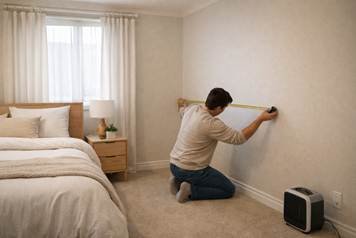
Room details
- Floor area: 12 m².
- Ceiling height: 2.5 m.
- Insulation: average.
- Usage: evening + sleep.
Method A — Area-based rule (W/m²)
A common rule is:
- ~100 W per m² for average insulation
12 m² × 100 W/m² = 1,200 W
✅ Suggests a ~1,200W heater
Method B — Volume-based rule (W/m³) (recommended)
Calculate volume:
12 × 2.5 = 30 m³
Apply average insulation heat density (mid-range used here: 35 W/m³):
30 × 35 ≈ 1,050 W
✅ Suggests a ~1,000–1,200W heater
Why the results differ slightly
- The area method assumes a standard ceiling height.
- The volume method explicitly accounts for how much air you’re heating.
- In higher-ceiling rooms, the difference becomes much larger.
Key point: the volume method stays realistic even when ceilings or insulation aren’t “standard.”
When to use each method
Use W/m² if:
- ceilings are normal height;
- you want a fast estimate.
Use W/m³ if:
- ceilings are higher than normal;
- comfort matters more than speed;
- you want a more realistic portable-heater estimate.
DecisionEdit’s recommendation is the volume method, because it matches portable heater use more reliably.
Decision Anchor 1: Are you in the “easy zone”?
If your estimate is under ~1,000W, you’re in the easiest category.
That usually means:
- one heater can work well;
- comfort depends more on drafts + placement than raw power;
- oversizing won’t improve comfort much — it mainly increases runtime cost.
If your estimate climbs above ~1,500W, you’re moving into “big-room territory,” where strategy becomes more important than wattage.
Example 2 — Home Office

Room details
- Size: 10 m².
- Ceiling height: 2.7 m.
- Insulation: average.
- Occupancy: one person, seated.
Calculation
Volume:
10 × 2.7 = 27 m³
Apply mid-range for average insulation:
27 × 35 ≈ 950 W
✅ Result: a 750–1,000W heater is usually enough
Practical notes
- Spot heating often beats whole-room heating in offices.
- An infrared heater can feel warmer than the calculation suggests because it focuses comfort where you are.
- If you’re sitting still for long periods, comfort matters more than “fast warm-up”.
Example 3 — Living Room

Room details
- Size: 22 m².
- Ceiling height: 2.8 m.
- Insulation: average.
- External walls: multiple.
Calculation
Volume:
22 × 2.8 = 61.6 m³
For living rooms, it’s safer to lean higher in the range (especially with external walls), so here we apply ~40 W/m³:
61.6 × 40 ≈ 2,460 W
✅ Result: one standard portable heater is usually not enough for whole-room heating
What this means in practice
Better options are:
- two 1,200–1,500W heaters, placed strategically;
- or one heater + central heating support;
- or spot heating aimed at the seating area (infrared works well here).
Portable heaters can absolutely make a living room comfortable — but the strategy matters.
Area vs Volume: Why Room Height Matters
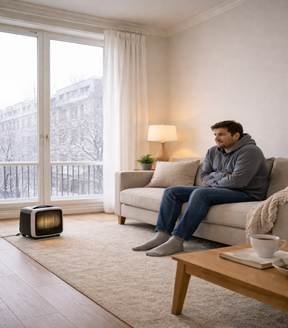
Floor area tells you how big the room feels. But portable heaters have to heat the air volume and the surfaces around you.
- Area (m²) = the floor size.
- Volume (m³) = the amount of space the heater must keep warm.
That’s why ceiling height changes the outcome dramatically.
Comfort isn’t only about air temperature
Even in a room with the same thermostat reading, comfort can feel totally different depending on:
- cold walls and floors (they pull heat from your body);
- drafts and air movement;
- heat rising and staying above you;
- uneven temperature distribution.
This is often described as perceived (operative) temperature — what you actually feel, not what a number says.
The key idea is simple:
- How heat behaves inside the room affects comfort as much as heater output does.
- Good insulation and fewer drafts keep warmth where you live — not near the ceiling.
One Heater or Two? (Decision Table)
This is the moment most people get wrong — because they try to solve everything with one big heater.
Use this table as a practical decision rule:
| Room size & condition | Recommendation |
| ≤ 12 m², well insulated | One 750–1,000W heater |
| ≤ 15 m², average insulation | One 1,200–1,500W heater |
| 15–20 m², average insulation | One 1,500W heater (borderline) |
| > 20 m², average insulation | Two heaters recommended |
| Drafty / poorly insulated | Increase power OR use spot heating |
| High ceilings (>3 m) | Two heaters often work better than one |
| Desk or sofa zone | One infrared heater is often enough |
Key insight: two lower-power heaters placed well often provide better comfort than one high-power unit trying to push heat across a large space.
Decision Anchor 2: The 1,200–2,000W decision fork
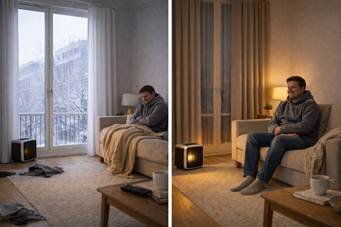
If your estimate is 1,200–2,000W, you’re at the fork where most people buy the wrong setup.
You have two smart options:
- one higher-power heater for faster warm-up
- or two smaller heaters for better comfort, fewer cold zones, and more even coverage
If you want the room to feel warm everywhere you sit, two smaller heaters often win.
Important Electrical Limits to Remember
Portable heaters pull a lot of power. And problems usually happen when people treat them like “normal appliances.”
Practical rules that apply in most homes:
- High-power heaters can be near the practical limit of what a single outlet should run continuously
- Running multiple heaters on one circuit can trip breakers or overload wiring
- If using more than one heater, it’s usually safer to spread them across separate outlets
Editorial note: Electrical standards vary by country and building age. Always follow the heater manufacturer’s guidance and avoid extension leads or power strips for high-wattage heaters.
The Bottom Line on Heater Sizing
Portable heaters should be sized for comfort — not theoretical heat loss.
The most reliable decision logic is:
- use room volume (m³), not just floor area
- adjust for insulation using the W/m³ ranges
- don’t brute-force large spaces with one heater
- use spot heating when the room is big, leaky, or high-ceilinged
- when in doubt, two smaller heaters beat one oversized heater
Regional Examples: UK Flats, EU Apartments, and US Homes
Portable heater sizing works the same way everywhere — but electrical realities and building styles vary.
Below are realistic examples using the DecisionEdit W/m³ method, plus what that means in practice.
UK Example: Modern Flat Bedroom (Typical 230V / 13A plug)
Scenario: London-style flat bedroom
- Room: 11 m²
- Ceiling height: 2.4 m
- Insulation: average to good
- Use case: evening + sleep
Step 1 — Volume
11 × 2.4 = 26.4 m³
Step 2 — Heat density
Average/decent insulation: 30–35 W/m³
Estimated requirement
26.4 × 35 ≈ 924W
✅ Practical decision:
- 1,000W is usually enough for steady comfort
- if you want a quicker warm-up (or it’s draftier), consider 1,200–1,500W
EU Example: Older Apartment Living Room (230V / commonly 16A circuits)
Scenario: older EU apartment living room
- Room: 20 m²
- Ceiling height: 3.0 m
- Insulation: average to poor (older windows, more drafts)
- Use case: whole-room comfort for 2–3 people
Step 1 — Volume
20 × 3.0 = 60 m³
Step 2 — Heat density
Draftier / older: 40–45 W/m³
Estimated requirement
60 × 45 = 2,700W
✅ Practical decision:
- one portable heater usually won’t feel like “whole room warmth”
- better options:
- two heaters (around 1,200–1,500W each), positioned across the room;
- or spot heating (infrared) aimed at the seating area.
US Example: Home Office or Bedroom (Typically 120V / 15A circuits)
Scenario: US home office
- Room: 120 ft² (≈ 11.1 m²)
- Ceiling: 8 ft (≈ 2.44 m)
- Insulation: average
- Use case: seated work comfort
Method A — US rule of thumb
A widely used sizing shortcut is:
- ~10 watts per square foot
120 ft² × 10 W/ft² = 1,200W
Method B — DecisionEdit volume method
Volume:
11.1 × 2.44 = 27.1 m³
Average insulation estimate:
27.1 × 35 ≈ 950W
✅ Practical decision:
- either approach can work depending on comfort expectations
- the volume method is easier to adjust if you’re spot heating or controlling drafts
US reality check (important)
Many US space heaters cap at around 1,500W, and if you’re still cold at that level, whole-room heating may not be realistic with a single unit — especially in leaky rooms.
Mini Box-Out: Why electrical limits matter (UK vs EU vs US)
Understanding local electrical limits helps you decide whether one heater or two is more realistic.
Practical takeaways:
- UK/EU homes can often run a single high-power heater more comfortably due to higher voltage.
- US homes are more limited — and many heaters are designed around the practical ceiling of standard circuits.
- In any region, two smaller heaters on separate outlets can be safer and more comfortable than forcing one heater to do everything.
Decision shortcut reminder:
If your calculation exceeds ~1,500W, consider two heaters, especially in large or drafty rooms.
Conclusion: Comfort Over Complexity
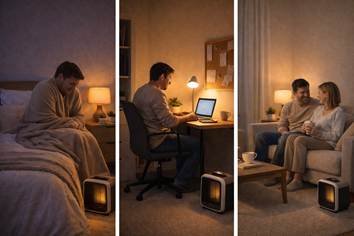
Portable heaters work best when you size them for how people actually live.
The DecisionEdit method is straightforward:
- calculate volume;
- apply realistic W/m³ ranges;
- use one heater for smaller rooms;
- use two heaters or spot heating for larger, taller, or draftier spaces.
In Part 2, we’ll adjust your decision using:
- insulation and air sealing;
- ceiling height effects;
- noise tolerance;
- and electricity cost logic.
So your final heater choice isn’t just “correct on paper” — it’s comfortable and practical to use every day