Portable Heaters for Bedrooms, Living Rooms, and Small Flats
Use-Case Matters More Than Specs
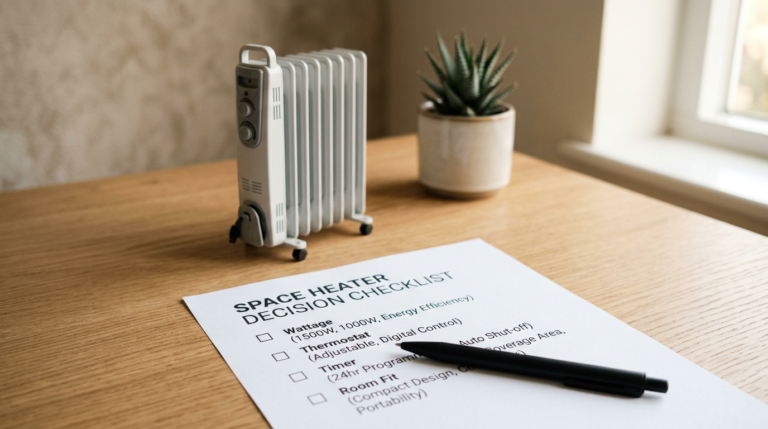
This guide isn’t a “top 10 list.” It’s a practical decision system. Instead of asking “What’s the best heater?” you’ll leave with something more useful:
- the right heater type for your space;
- the right way to use it;
- the most common mistakes to avoid;
- a shortcut table you can follow in 30 seconds.
Most people shop for a portable heater the wrong way: they compare wattage, “efficiency,” and feature lists — then wonder why the room still feels uncomfortable.
Here’s the truth: portable heaters are simple devices. Nearly all of them turn electricity into heat at roughly the same rate. So, if two heaters draw the same power, they’ll deliver a similar amount of heat into your home.
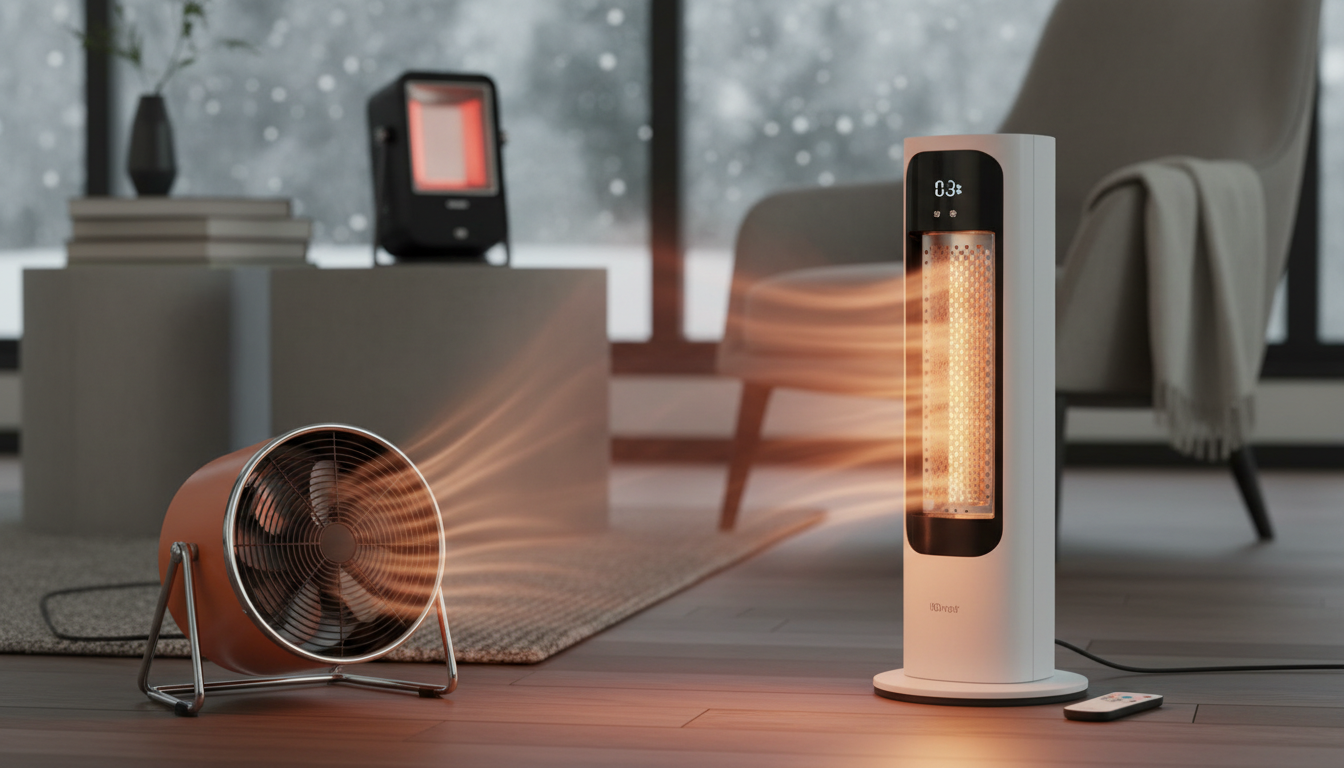
The difference isn’t magic performance. It’s how the heat is delivered — and whether that delivery matches the room you’re trying to warm.
A heater that feels perfect in a bedroom can be irritating in a living room. A powerful unit in a small flat can be noisy, expensive to run, or too aggressive for sleep. Your comfort depends on several factors: how well a heater manages noise, its runtime, the room’s size, insulation quality, and placement. These elements are far more significant than just the numbers on the product label.
Who this is for:
- You want warmth without running the heating all day.
- You need a quiet heater for sleep.
- You’re heating a drafty living room or open-plan space.
Quick Decision Snapshot (Read This First)
If you want the decision rules in plain English, start here:
Bedrooms
Quiet + steady heat wins.
Choose heaters designed for stable comfort and safe overnight use.
Living rooms
Spread matters more than power.
Aim for background warmth plus targeted comfort where people sit.
Small flats/studios
Control beats output.
Use short, efficient heating bursts and zone the heat where you live.
Two rules that save most people money:
- If quiet matters, avoid fan-based heaters (especially for sleep).
- If cost matters, stop chasing “efficiency claims” — runtime + heat loss control your bill.
Now let’s apply this properly, space by space.
Portable Heaters for Bedrooms
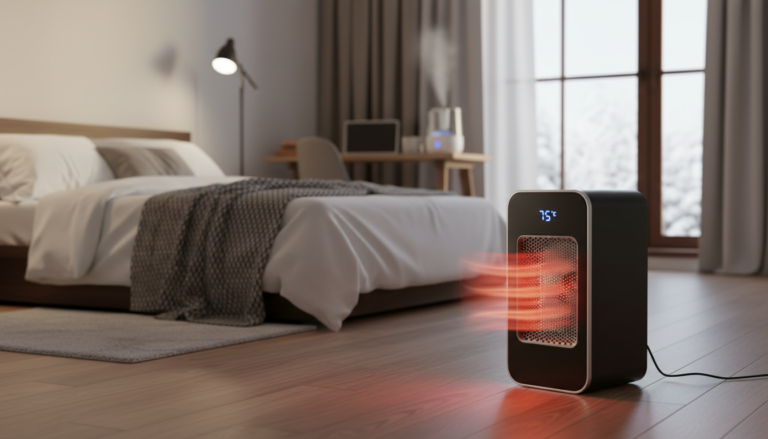
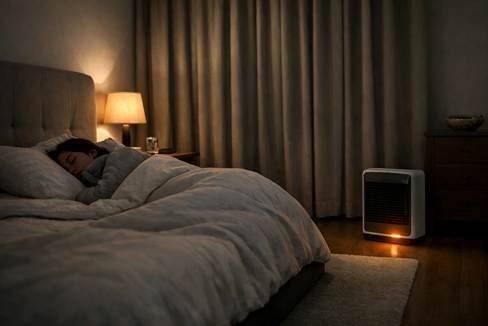
Bedrooms are the most “sensitive” room in the house because your heater isn’t just fighting cold air — it’s competing with sleep quality, noise tolerance, and safety.
A bedroom heater that works is rarely the most powerful. It’s the one that delivers stable warmth, quietly, without forcing you to keep it running all night.
Bedroom priorities (in order)
1) Quiet operation
If you can hear it, you’ll notice it.
Bedrooms need heaters that run quietly, even when the thermostat adjusts.
2) Gentle, steady warmth
Fast blasts of heat can feel uncomfortable at night.
In bedrooms, comfort improves when the room stays evenly warm, not when it spikes hot and cool.
3) Safety first
Bedrooms have bedding, curtains, tight layouts, and less supervision.
Tip-over protection and overheat shut-off aren’t “nice extras” — they’re baseline requirements.
4) Controlled runtime
Overnight heating can become expensive fast.
Timers, thermostats, and sensible power settings matter more than “smart features.”
Heater types that work best in bedrooms
✅ Best choice: Oil-filled radiator
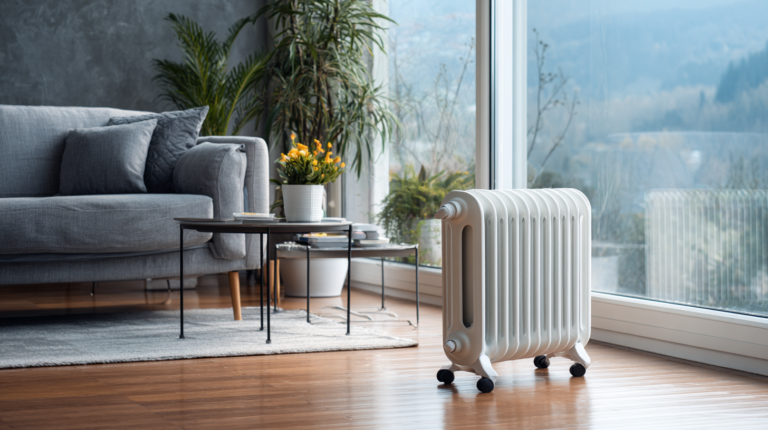
Oil-filled radiators are the bedroom specialist:
- silent operation;
- slow, stable warmth;
- strong heat retention once warmed up;
- ideal for longer, calmer heating cycles.
These are usually the best match for “heat while sleeping” or “pre-warm the room then maintain.”
✅ Good choice: Convector heater
Convector heaters warm the room using natural air movement. They can be excellent if:
- the bedroom is small–medium;
- insulation is decent;
- you want background warmth with minimal noise.
✅ Situational choice: Infrared (for targeted warmth)
Infrared heaters can feel great when you want direct warmth — like warming a desk chair, your feet, or a specific spot before bed.
But they’re not always ideal for steady overnight room heat unless carefully placed.
What to avoid in bedrooms
❌ Avoid: Fan heaters overnight
Even “quiet” fan heaters create airflow sound and frequent cycling.
They’re often the #1 cause of sleep disruption and “why does my heater feel annoying?”
❌ Avoid: Oversized heaters in small rooms
Overpowered units can overheat the bedroom quickly, then shut off, then restart.
That constant cycling creates noise and uneven comfort.
❌ Avoid: No timer / weak controls
A heater that runs continuously overnight is the fastest route to a painful electricity bill.
Bedroom scenarios (what works)
Scenario A: Well-insulated bedroom
You don’t need brute force — you need stability.
A modest heater on low/medium with steady control will feel better than a high-output unit constantly cycling.
Scenario B: Older home, draughts, cold walls
If you feel cold even when the air is warm, it’s usually because cold surfaces are “pulling” heat from you.
In this case, steady heating works best — but sealing draughts and improving insulation can matter more than buying a bigger heater.
Scenario C: You only need warmth before sleep
Don’t heat all night if you don’t need to.
Pre-warm the room for 20–40 minutes, then reduce the thermostat or switch to a lower setting.
Bedroom takeaway
For bedrooms, choose quiet, steady, safe heating — and prioritize control over raw output.
If your heater improves comfort without making you think about it, it’s the right one.
Portable Heaters for Living Rooms
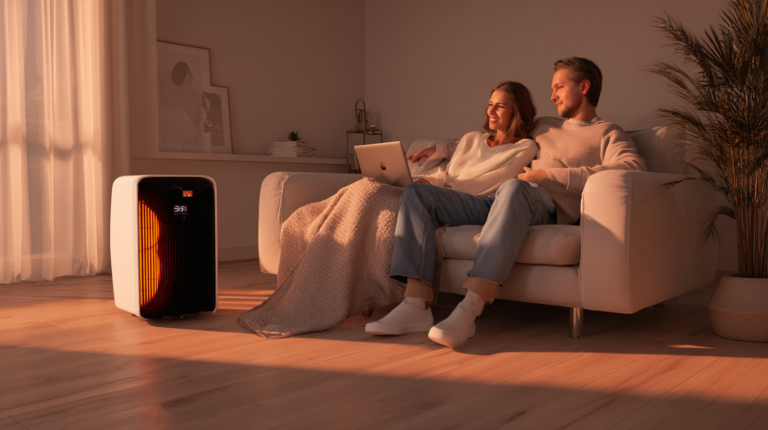
Living rooms are where portable heaters get tested hardest. These spaces are larger, more open, and more variable — and people expect “whole-room comfort” even when the space is working against them.
The big mistake here is simple:
People try to solve a spread problem with more power.
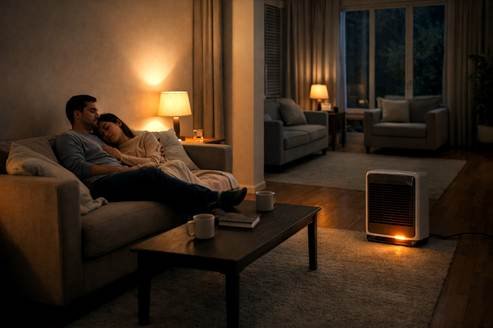
Why living rooms are harder to heat
Living rooms often have:
- more air volume than bedrooms;
- higher ceilings (common in UK/EU older homes);
- more door opening and airflow;
- cold external walls or large windows;
- mixed comfort needs (different people, different preferences).
And there’s an extra factor many people miss:
If walls, windows, and floors are cold, warm air alone won’t feel warm.
Your comfort depends partly on the “average temperature” of the surfaces around you — not only the air temperature.
So if you’re sitting near a cold wall or window, you can feel chilly even when the room thermostat looks fine.
Two strategies that work in living rooms
Strategy A: Background warmth (whole-room baseline)
This is the “keep the room pleasantly warm” approach.
Works best when:
- the room is smaller or well-sealed;
- you want consistent comfort for the whole family;
- you’re staying in the room for hours.
Best heater types:
- oil-filled radiators;
- convectors.
Success depends on:
- keeping airflow clear;
- not blocking the heater behind furniture;
- avoiding open doors and constant leakage.
This approach is simple and comfortable — but it struggles in large, drafty spaces.
Strategy B: Zoned comfort (heat where people sit)
This is the “warm the human, not the entire house” approach.
Works best when:
- ceilings are high;
- the room is large or leaky;
- people spend long periods seated in one area;
- you want comfort without heating unused corners.
Best heater types:
- infrared (aimed at seating zones);
- plus a background heater if needed.
Zoned heating often feels better because it targets the comfort zone directly — rather than trying to force the entire room into perfect uniform warmth.
Two smaller heaters vs one large unit (often smarter)
In medium to large living rooms, two smaller heaters can beat one large heater because you can:
- spread heat more evenly;
- reduce extremes (hot near heater / cold elsewhere);
- keep surface temperatures safer;
- work within electrical limits more comfortably.
This matters especially in regions with lower circuit capacity for a single unit.
Cost and comfort: what actually reduces the bill
If you want lower heating costs, this is the hierarchy:
1) Reduce heat loss
Draughts and leakage will outspend almost any heater choice.
2) Heat the used zone
Heating the seating area beats heating the entire volume of air.
3) Control runtime
A heater that runs nonstop costs more than a heater that runs smart.
Common living-room errors (the ones that waste money)
Mistake 1: Heating a space
A heater pointed at an unused corner is pure waste.
Mistake 2: Placing the heater behind furniture
Blocked airflow kills circulation and makes performance feel “weak.”
Mistake 3: Expecting one unit to beat ceiling height
Warm air rises. In tall rooms, comfort at sofa level is the challenge.
Mistake 4: Turning up the power instead of fixing the leakage
If you stay cold, it’s often not because the heater is too small — it’s because the room won’t hold heat.
Living room takeaway
Living rooms reward strategy, not brute force.
Choose:
- background warmth for smaller, tighter rooms;
- zoned comfort for bigger or leakier rooms;
- two heaters when spread matters more than peak output.
Attachment 1: Choosing a Portable Heater by Space, Comfort, and Constraints (one-table summary)
| Space / Use Case | Main Priority | Recommended Heater Types | Typical Power Range* | Key Considerations | Common Mistakes to Avoid |
| Bedroom | Quiet, steady comfort | Oil-filled radiator, Convector | 750–1,200 W | Low noise, stable heat, and overnight safety | Fan heaters, oversized units, no timer/thermostat |
| Living Room (small/well-insulated) | Even background warmth | Convector, Oil-filled | 1,200–1,500 W | Placement, airflow, surface temperatures | Blocking airflow, heating unused space |
| Living Room (large/drafty) | Flexible comfort | Two heaters (mixed types), Infrared for seating | 2,000–3,000 W (split across units) | Zoning, ceiling height, drafts | Expecting one heater to do everything |
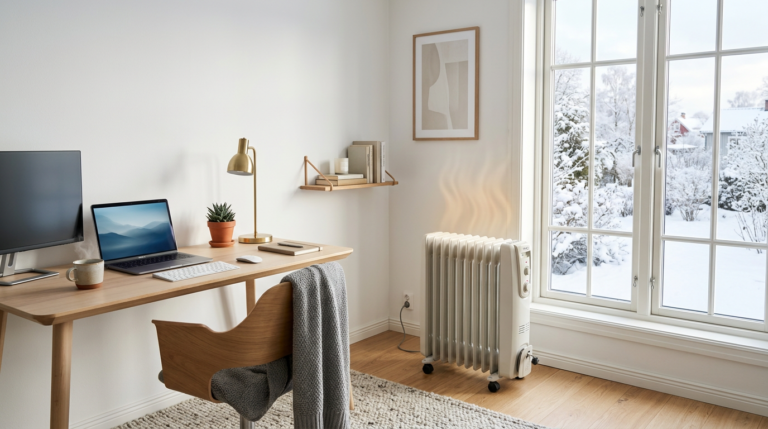
| Home Office/Desk Area | Personal comfort | Infrared, Small convector | 500–1,000 W | Spot heating beats whole-room heating | Overheating the entire room |
| Studio Flat | Control & efficiency | One main heater + one spot heater | 1,000–1,500 W total | Noise carryover, power limits | Continuous max output |
| One-Bed Flat | Zoned heating | Separate heaters per zone | 750–1,500 W per zone | Timers, movement between rooms | Heating empty rooms |
| Poorly Insulated Room | Heat retention | Any + insulation upgrades | +20–40% vs average | Draft-proofing matters more than wattage | Buying “bigger” instead of fixing leaks |
| High-Ceiling Room (>3m) | Occupant-level comfort | Infrared + background heater | Higher than floor-area estimates | Stratification, air mixing | Using W/m² only |
| Noise-Sensitive Use | Silence | Oil-filled, Infrared | Lower sustained power | Thermostat cycling noise | Fan-based designs |
| Cost-Sensitive Use | Runtime control | Any with good controls | Matched to room volume | Wattage x runtime drives cost | “Efficient heater” marketing claims |
Power ranges assume average insulation. Poor insulation or high ceilings increase the required power.
Portable Heaters for Small Flats & Studio Apartments
Small flats look easier to heat — but they can be trickier in practice.
Because in a studio or compact apartment:
- heat travels everywhere;
- noise travels everywhere;
- power limits can be tighter (especially in older buildings);
- it’s easy to overheat fast.
In small spaces, the goal isn’t “more heat.”
It’s controlled heat where you live, without turning your whole flat into a sauna.
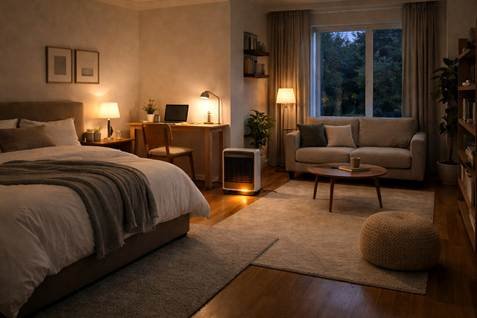
The small-flat problem in one line
You don’t have rooms — you have zones.
Your flat is functioning as a bedroom, living room, and workspace at the same time. So your heater needs to match shifting use cases across the day.
Smart strategies for small spaces
Strategy A: One baseline heater + one spot heater (the best system)
This is the simplest high-comfort setup:
- The main heater keeps the flat “not cold”.
- Small spot heater makes the active zone comfortable (desk/sofa).
This prevents you from running high power all day just to warm one chair.
Strategy B: Heat in short bursts (small flats warm up fast)
In compact spaces, continuous heating is often unnecessary.
Use:
- short warm-up periods;
- lower maintenance settings;
- timers so you don’t “accidentally heat the flat for 6 hours”.
Strategy C: Noise control matters more than you think
A heater that’s tolerable in a living room becomes unbearable in a studio because there’s nowhere to escape it.
If you live in a studio:
- prioritise quieter heater types;
- avoid constant fan noise;
- avoid aggressive cycling.
Safety and electrical reality (small flats edition)
Small flats are where unsafe setups happen — not because people don’t care, but because space forces compromises.
Do not:
- run heaters through extension cords;
- stack multiple high-draw heaters on one outlet;
- place heaters near soft furnishings in tight layouts.
Choose heaters that are easy to place safely and easy to move.
Typical small flat layouts (what works)
Studio flat
Zoned heating almost always wins.
Trying to “heat the entire volume” is how you overspend.
One-bedroom flat
Separate sleep heat and living heat.
Quiet heater for the bedroom, flexible heater for the living zone.
Older, poorly insulated flat
The heater isn’t the problem — heat loss is.
Draught-proofing and sealing can improve comfort faster than buying “more wattage.”
Small-flat takeaway
In compact spaces, comfort comes from control, not output.
Use less heat — smarter — where you actually sit and live.
Noise, Cost, and Safety: The Final Filters
Once you’ve matched the heater to the room, three filters decide whether you’ll actually enjoy using it:
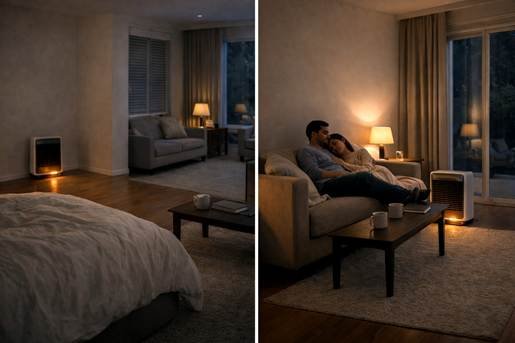
1) Noise tolerance
Bedrooms and studios demand quiet designs.
Living rooms can tolerate more, but irritation still adds up.
2) Cost control
Electric heaters convert power into heat similarly.
So cost comes down to:
wattage × runtime
Not marketing.
3) Safety
Tip-over shutoff, thermal cut-off, safe clearance zones — these matter more than fancy modes.
When people feel cold, they often compensate with unsafe placement or excessive runtime. The right heater choice reduces both problems from day one.
Summary: Match the Heater to the Space
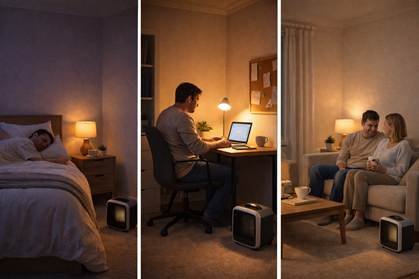
At this point, the decision should feel straightforward:
Bedrooms
Quiet, steady heating that protects sleep and controls overnight cost.
Living rooms
Spread and strategy — baseline warmth or zoned comfort (often both).
Small flats
Control and flexibility — minimal noise, smart runtime, and zoned heating.
The best heater isn’t the biggest or most expensive.
It’s the one that fits how the space is used — and keeps you comfortable without waste.
Final rule:
If you’re on the fence, choose the option with better noise control, runtime control, and placement flexibility — not the one with the largest power rating.
Attachment 2: Regional Electrical Reality Check
| Region | Typical Voltage | Practical Single-Heater Limit | Implication |
| UK | 230 V | ~2,000 W | One high-power heater is usually feasible |
| EU | 230 V | ~2,000–3,000 W | Depends on circuit design |
| US | 120 V | ~1,200–1,500 W | Two heaters are often needed for larger rooms |
Attachment 3: Universal Takeaways (Across All Rooms)
- All electric portable heaters convert electricity to heat similarly.
- Comfort depends on delivery, not wattage alone.
- Insulation and air sealing reduce costs more than changing the heater type.
- Two smaller heaters often outperform one large unit.
- The best heater is the one that fits how the room is used.
Attachment 4: Final Decision Shortcut
If the heater:
- is quiet enough to live with;
- matches the room’s volume, not just floor area;
- respects electrical limits;
- and runs less because the room holds heat.
→ You’ve picked the right heater.